Showing posts with label Crabapple. Show all posts

Tuesday, May 19, 2009

Crabapples & Flowering Pears

It was officially Spring two months back. But, Chicago weather currently seems to be into the Spring mode. This climate is simply amazing. The temperatures are perfect ranging from 60-65 degree F, slightly foggy, pleasant rains, lush green landscapes and trees set in colorful blooms everywhere.

Crabapples & Flowering pears are the trees dominating the landscape with its beautiful blooms at this time. We have three "Sugar Tyme" crabapples of which two of them failed to bloom this year. After doing some research I found out, it is possible that the flower buds might get affected if there is a bad winter & lot of temperature fluctuations. This is how the tree looked last year.

We have three "Chanticleer" flowering pears in our yard. All of them had perfect blooms. One was planted the previous year(2007) & the other two planted last year(2008). This tree looks very beautiful once it grows to a decent size (still couple more years for our trees to reach that size :-)).

"Sugar Thyme" crabapple with its pink buds, all set to bloom...

Closeup of the flower branch with the slgithly opened blooms...

Closeup of a single bloom....with some pink buds in the background...

"Sugar Tyme" Crabapple Blooms which turned white in color...once fully opened...

"Chantincleer" flowering pear blooms...
"Chantincleer" flowering pear blooms...closeup view...

Wednesday, May 28, 2008

New Beginnings!

Weather here is very unpredictable. There are some spring days followed by occasional cold days followed by some sunny days. But, with the arrival of spring, our garden got activated. There are some kinds of signs on each & every plant.
Flowering pear & crabapples were the first trees to invite spring with a display of white flowers all over the tree. Since our trees are small there is not much shape of the tree this year. Maybe in 3-5 years the crown of the tree will be more dense and will portray many more blooms.
Crabapples have the buds in dark pink color which fades to white when the flower blooms.


Thursday, December 6, 2007

A lonely spring flower in Fall

Did you know how the plants growing in extreme climates know when its spring & when its winter..?

The trees, shrubs and flowering perennials have adapted themselves in such a way that they can protect themselves in extreme temperatures. Evergreens are the ones which can stay green all through the year. So these trees has leaves which are modified to spikes or scales which has less water loss compared to the leaves. Deciduous trees /shrubs are the ones which lose there leaves in fall. Perennials are the ones which die back to their roots and start growing once the weather is conducive.

As the temperature begins to drop down, all the plants start preparing themselves for the winter. When they are almost ready for the winter and suddenly when the temperature starts rising on the following days, the plants get fooled that spring is arriving. Its the temperature which makes the plants think of the seasons.

This year we have planted a total of 18 trees, lots of evergreens, decicuous shrubs and perennials. Of these one tree got fooled with the temperature ups and downs for one flower. The flowering crabapple which is known for its enormous white blooms in spring had one single bloom. This was very surprising, but also very exciting that one bloom took the initiative to show what it will look like. The flower had 5 petals with milky white color and it was an absolute beauty. We are eagerly waiting to see the tree fully covered with such beautiful blooms in spring.

Wednesday, December 5, 2007

Extended West side bedline

In the L-shaped bedline post I mentioned that the bedline extends all the way on the West side of the fence, crossing the fence and continuing in the front yard.

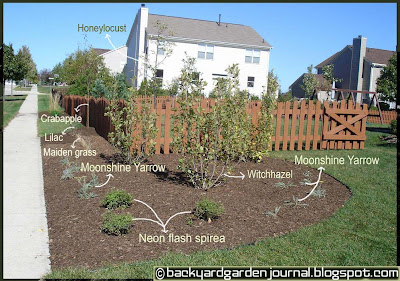
After the Vanderwolf pines is a flowering crabapple on the outside of fence, surrounded by some lilacs inside and outside the fence. This continues with couple of maiden grass and some sunny border speedwell. The extreme corner of the fence is highlighted with a gracefully arching tree called Honeylocust. This is followed by some tall deciduous shrub called Witchhazels which are known for the earliest spring attraction. The witchhazels are surrounded by some flowering perennials called "Moonshine yarrow" and some deciduous shrub Spirea.

On the outside of the fence, the bedline follows a curve pattern leaving a concave area of grass. Onto the extreme other end there are some Karl Forester grass and some Sea green juniper.